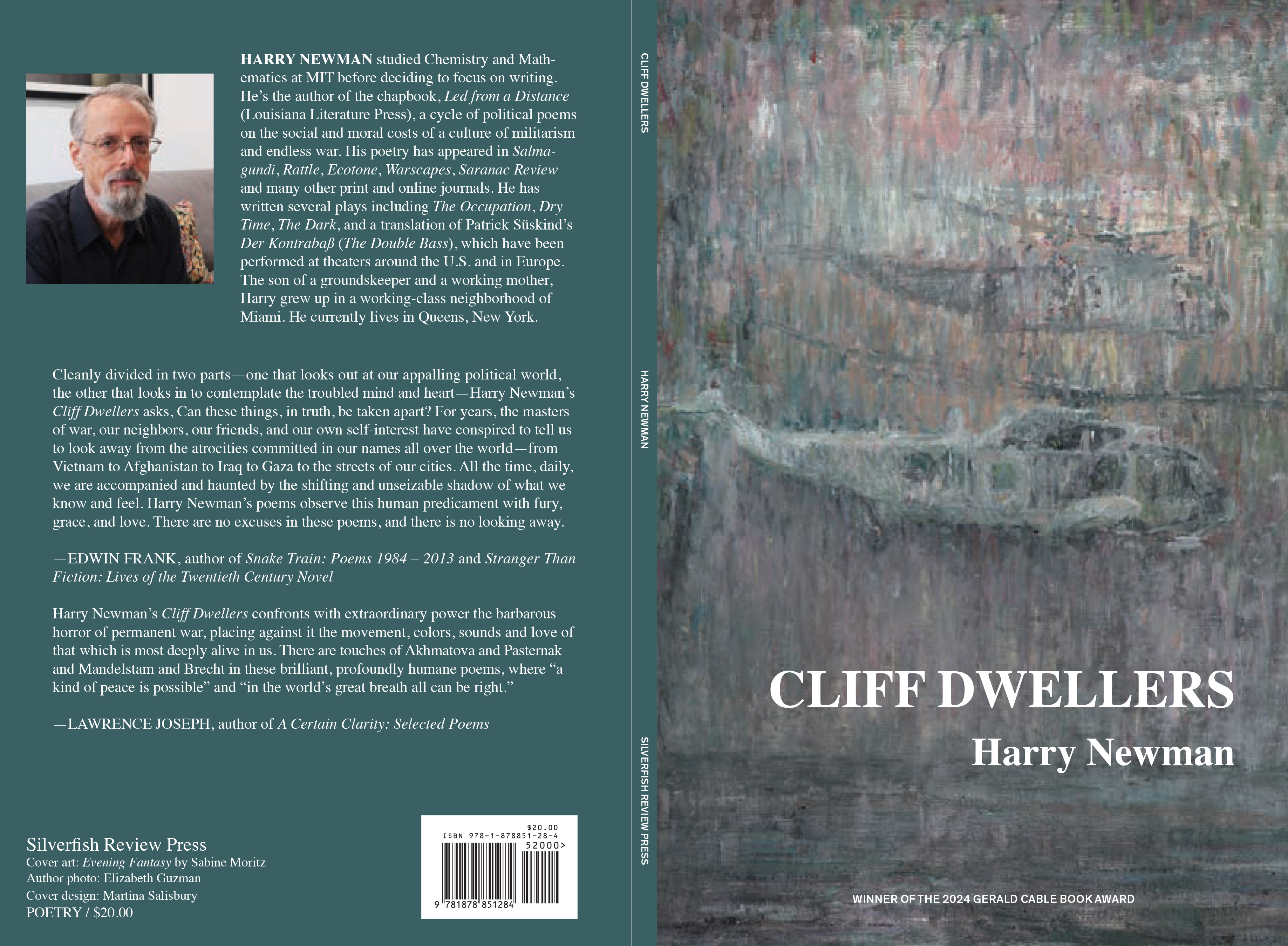
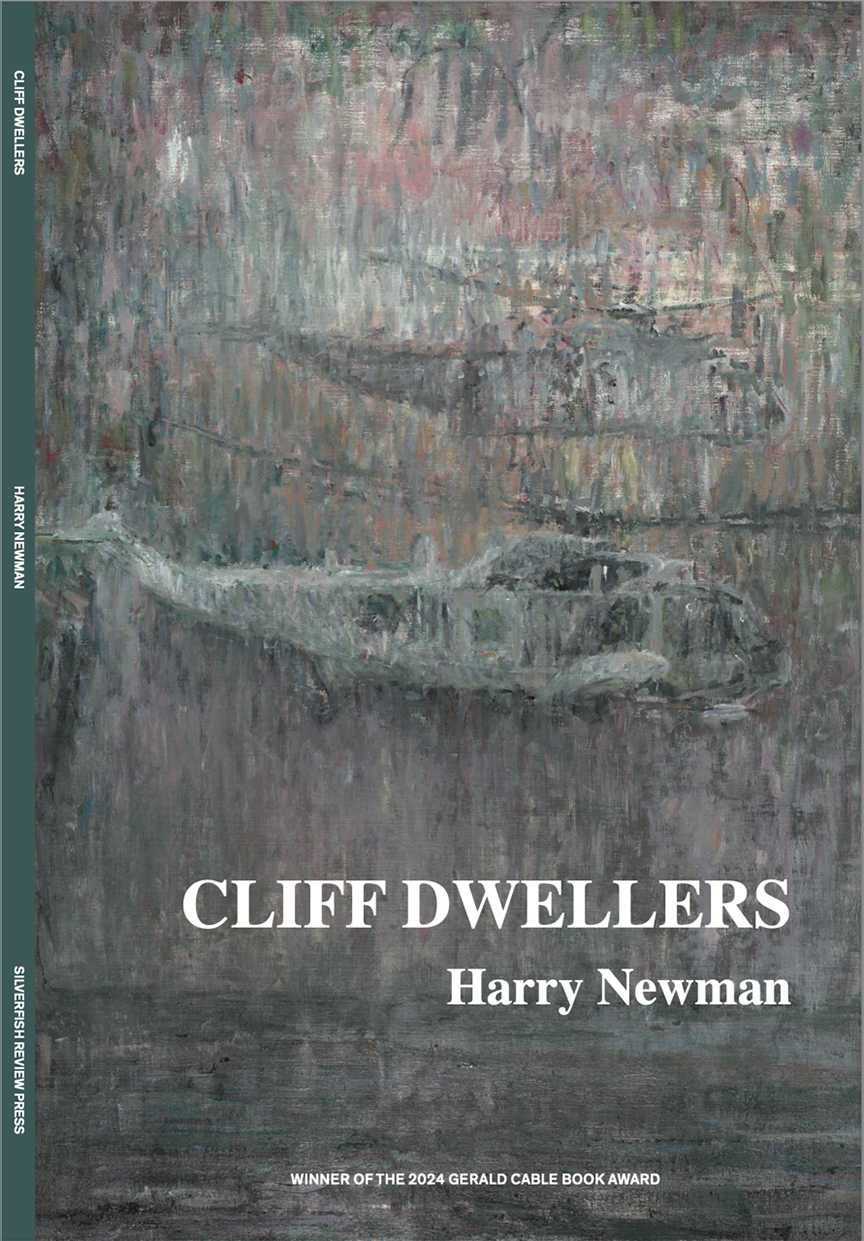
Congratulations to Harry Newman on the release of his new poetry collection, Cliff Dwellers, from Silverfish Review Press! You’ll want to read this.
an award-winning anthology dedicated to publishing innovative literary experiences

Congratulations to Harry Newman on the release of his new poetry collection, Cliff Dwellers, from Silverfish Review Press! You’ll want to read this.
Be ambitious for the work, not its promotion. Write, read, write, read, write with dedication. Anything you do that way for a decent period is something you’ll get better at. Publication will ensue once you’ve reached your better levels.
-Sydney Lea, “Orb Weaver at My Writing Cabin,” Volume XXX, 2026
Simply write, make sure you feel you are sending your very best, and, most importantly, believe in your work. It is very common for the fate of a single poem to find one editor rejecting it (with criticism) and another editor accepting the same piece (with praise).
–Yvette A. Schnoeker-Shorb, “Impulse Buying the Future,” Volume XXX, 2026
Just do it. I let decades pass without pursuing my writing dreams due to my fear of rejection. I regret those lost years. Rejection stings, but if I can survive it, you can, too.
-Jennifer Randall Hotz, “Silver Street,” Volume XXX, 2026
Don’t place all of your sense of a piece’s worth in the validation or attention it receives. You know what excites you; follow it, and whatever comes cannot be called failure.
-Joshua Zeitler, “Anna No, Anna No,” Volume XXX, 2026
I used to live near a cemetery, where I would walk sometimes to get out of the house and clear my head. In the cemetery, I found a headstone for a woman named Lucy and her husband. Her husband’s death date was in the 1800’s, but Lucy’s death date was left blank. I realized I wanted to write my way into this mystery.
-Joshua Zeitler, “Anna No, Anna No,” Volume XXX, 2026
Tenth grade geometry class. A lesson on cubes wasn’t holding me; a couple of lines came into my head, I wrote them down. I looked at the board, looked at what I wrote—and spent the next three years of high school math class writing. My math grades suffered, but writing took hold and has never let go.
-Scott T. Hutchison, “Bowls of My Father’s Anger,” Volume XXX, 2026
I wrote my first book at nine years old—a story about my sister’s dog, Kazan. I have always had a pencil and paper in hand, always jotting down things that occur to me…words on paper—it’s who I am.
-Judith Mikesch-McKenzie, “Having Faith in the Speed of Light, “Volume XXX, 2026
Early on—probably around grade five. I went to a parochial school and we were given a poetry writing assignment. The next day, there were some VIP visitors making the rounds of the classroom, and I was asked to read my poem for our guests. It was a sing-song piece of work, with rhyming end-words chosen simply because they rhymed (i.e., hill/ill), and the rules said a poem had to rhyme or it wasn’t a poem. Nonetheless, I was very serious about my poem and was mortified when the guests laughed. It was an early lesson in the art of humility, and I vowed to persist.
-T. Clear, “Here on Earth,” Volume XXX, 2026
When did you realize you wanted to write?
I always dabbled with writing. I remember as a kid starting novels on an old typewriter. I’d write a few pages or a chapter and then forget about them forever, whatever they were. I started writing poetry and my first novel manuscript in my last year of high school and finished the latter during my first year of college (it was crap). That first year of college, though, my poems began to get accepted to small horror and sci-fi magazines, and that drove me on. A year or two later, I turned to more literary poetry and prose, and that’s when I really felt it, believed it, wanted to continue that for the rest of my life.
Is what you write now the same as what you wanted to write when you started?
Oh no. No no no. I started out writing genre fiction and awful rhyming poetry. I moved through experimental and Beat-inspired work, spent some time writing comedic stuff, and finally found my place writing literary work that not only moved me but I was much better at creating. Even that style has evolved many times over the years.
What is a favorite piece that you wrote? What is a favorite piece that you’ve read?
As for mine, the one that always comes to mind is “Watching the Wizard of Oz” in prison, which you can find on the Rattle website. Favorite poems include Stephen Dobyns’s “Uprising,” Adam Zagajewski’s “Try to Praise the Mutilated World,” Julie Sheehan’s “Hate Poem,” and the entire books The Evening Sun by David Lehman and Felon by Reginald Dwayne Betts.
How have other authors influenced your own writing and style?
I can look back and trace a litany of authors and books that, the first time I read them, changed my entire perspective. There are far too many to list, but here are a few. The first time I read Naked Lunch by William Burroughs, it opened my mind to possibilities. Neruda’s Twenty Love Poems and a Song of Despair taught me beauty. Lehman’s book The Evening Sun and Zagajewski’s Without End came into my life at exactly the right time to shift my focus in ways that still linger in my writing. That’s just a few. I read too much, really: novels, poetry collections, journals, whatever I can get my hands on (and afford, which is often the problem, being an unemployed ex-con). I read all the Best American things: poetry, short stories, debut fiction, short fictions. It all moves me.
How does using technology—Instagram, Twitter, Facebook, or even just your phone—influence how you write?
I use Facebook and Twitter, mostly to keep up with what others are doing and post about my publications. It’s grown my audience, but I don’t really use it for my writing unless some random thing inspires me to write some other random thing. Google Search is the main technology I use. I often get paranoid that I’m misspelling something or not using a word correctly despite having used it that way for more than thirty years, so I’m always searching to make sure I’ve got things right (and sometimes don’t). I don’t use AI for anything to do with writing. I have contempt for it—not AI itself, but for having it in any way connected to the arts. Nor do I write on my phone, although I do use it to take notes on things I see occasionally. That’s handy.
What advice would you give an aspiring writer who wants to put their work “out there”?
I say some version of this all the time to young writers discouraged by rejections. The whole process is a crapshoot. It’s not just about getting the poems or stories right; it’s about getting the right pieces to the right editors on the right days when nobody yelled at them over the phone or ran over their dog in the driveway. Just keep submitting and the acceptances will come. Also, keep tightening the screws on your work.
What have your experiences been like interacting with the publishing world? How about with student editors working on literary journals?
I’ve been doing this a long time. I’ve had good experiences and bad ones with every type of editors and literary journals. Some journals I’ve expected to be small and obscure turned out to be glorious incarnations, while some I thought would be among the best mishandled my work or misspelled my name (which happens far more than I’d expect). I’ve dealt with publishers that really cared for my books and did everything they could for them, and others that put the book out and then promptly folded or quickly moved on to the next book without any support. I’ve had five-minute acceptances and rejections that took two years.
Where do you typically seek inspiration and guidance for your work?
Inspiration comes from everywhere. I write about everything I see or experience, dreams, all the weird or twisted thoughts that go through my head. The best way to find inspiration is just to live and have interesting moments, good and bad. As for guidance, I’m self-taught, especially with poetry. My guides are other poems. I read way too much. I consume books and journals as much as my limited finances allow. With prose, I had one class as an undergrad, but I had already written three novels before I took the class (all in different styles, two of them terrible). The main thing I learned in that class was not about writing but just to read better. That’s the main thing anyone should learn. Read as much as you can of what you want to write. Read other things, too, just to get a feel for possibilities, but mainly read what does the sort of thing you want to do. You gain a lot from that simple act.
How do you feel about having your writing appear and read alongside other works in a literary collection?
I love it. It gives me things to read (for free) from people I might connect with, especially now in the age of social media. I crave moments of discovery when I read someone new and think, goddamn that’s good!
If you could have a drink or a chat with any living author, who would it be? Why?
Christopher Moore. He’s the one author from my early days of writing horror and comedy that I still read everything he writes. He tells good stories and, especially when you read them aloud with a companion, those stories often result in many spit takes. Picture chunks of lamb korma flying uncontrollably across the room. I did chat with him a few times back in the days of America Online. What a different world that was. He was always friendly. I talked with Tom Clancy on there too, but always found him to be a bit of a dick.
Do you have any professional advice for prospective authors seeking to be published? What did the process of getting your first published work look like?
Oh, hell. That’s a long story. I wrote mostly novels for the fist fifteen years of my life. About a book a year. I couldn’t sell them. I had a reputable agent, and she couldn’t sell them. It was a very self-destructive time in my life, and the feelings of failure were a big part of my drug problems, crime, and ultimately imprisonment, which—again, Fate—led to the writing of my best book, a collection of poetry called The Prisoners that was accepted on the day I made it out. My first published book was a couple years before prison, though. It was a small poetry book called The Beautiful Girl Whose Wish Was Not Fulfilled. The publisher was the editor of a magazine who published many of my poems over the preceding years and had me up to do several readings in central and eastern Pennsylvania. She decided one day that she wanted to publish a book of my poems, so I put a manuscript together for her, and she released it. It was a gorgeous little book, and it was one of the most exciting times of my life. Unfortunately, I was already too far gone by that point, between the self-doubt and the drug habit. I didn’t appreciate it nearly as much as I should’ve.
How do you manage writer’s block?
I don’t have it. Never have. I always write something when it’s time to write. If nothing exciting is happening to write about, then I’ll write about a shoe or a deer or a layer of dust on my baseboards. It doesn’t matter. I’ll write something. Maybe it’ll be great, maybe awful. But that’s a decision for later. I can always edit it or discard it. My history is littered with the corpses of discarded poems. I’d put their bodies on pikes like a paper Vlad the Impaler, but there’d be so many that it might ward off other poems.
What do you think makes a story or poem “good”?
The main thing for me is a sense of connection to the strange. I want to feel what the author is feeling and live their lives in a way that what they’ve been through, happy or sad, common or unique, seems like something I can understand and experience as I was there, a part of it, and in that sense, a part of the poet as well. It’s what I aim for in my writing, too. Sometimes it works, sometimes not.
Is there a book, story, or poem that changed your perspective on the world? If so, did it influence your writing and/or the way you write?
I already answered this in one of the questions above, so I’m going to go in a different direction and tell you a story about why I love Clackamas Literary Review and always submit here: Around the turn of the millennium, I went with a friend to an alternative club in Huntington, West Virginia, which had replaced a previous alternative club on the same spot. We sat there listening to a band and had a great chat about how the new bar brought up so much nostalgia for the old one, and how things change, and what that meant for our lives. I went home and wrote a poem called “Ghost Club” that I submitted to CLR (my first time submitting here). It was accepted, and about eight months later, published in a gorgeous edition. Meanwhile, my friend was headed off to Alaska for some job or other. He flew cross-country to, I believe, Washington, but I’ve forgotten the details. Anyway, he sent me an e-mail from there. He had walked into a bookstore while there, spotted CLR on the shelf, thought it looked good so picked it up, saw my name, read the poem, and wrote to tell me how crazy it was, and how cool, to go all the way across the country and pick up a random journal only to read a poem with me in it. That’s big-F Fate. I have loved CLR ever since.
I return to the way authors like Sherwood Anderson and Elizabeth Strout have created characters who are oddballs (Anderson’s people in Winesburg, Ohio) and cranky (Olive Kitteredge in Strout’s stories). As a reader, I care about these characters even though they have flaws, and I think it is bold of these authors to create characters like this and to make them the stars of their stories.
-Lynn Levin, “Amanda the Vigilant,” Volume XXX, 2026
I like writers who break down the norms of what is expected. I like Hemingway and Dostoevsky, and the Oakland-based writer, Alison Luterman.
-Paul Rabinowitz, “The Walk,” Volume XXX, 2026
I love Lauren Groff. She has taught me to be bolder with verbs.
-Susan Melinda Morée, “The Fog Sounds: A Tragedy in Less Than One Act,” Volume XXX, 2026
Frost has been crucial in my effort to make my poetry, if not totally accessible, not deliberately obscurantist either. One can be complex without being merely complicated.
-Sydney Lea, “Orb Weaver at My Writing Cabin,” Volume XXX, 2026
When did you realize you wanted to write?
Pretty early in high school I started to write in a notebook. It started by trying to write a song, and I found it so difficult. I remember sitting there for hours and never finishing it. The difficulty of trying to translate my thoughts into words fascinated me and that never went away. My childhood was complicated, so trying to make sense of that through writing (whether that writing was fiction or nonfiction) helped me sort through events and moments I needed to reflect on. It’s that difficult translation between thought and words on the page that’s very interesting, and I don’t think I would find so much joy through writing if it was easy.
Is what you write now the same as what you wanted to write when you started?
In a sense, yes, but it’s so much more nuanced than how I started. I didn’t start by wanting to write about any specific thing other than my life and questions that simply came up by living. That has never changed. My understanding of poetry, the books I’ve read, and the writers I’ve studied with, or have become friends with, all have deepened my process, which is completely different than how I started.
How does using technology—Instagram, Twitter, Facebook, or even just your phone—influence how you write?
Technology mostly has a negative impact on my writing. The positives are obvious. It’s nice to be friends with a lot of great writers through social media. You can talk to them. You can see what their latest works are and read them before they come out in book form. All of that is very interesting, and given so many of these people do not live where I live, feeling “connected” to them in some way is great. It’s also nice to be writing and realize you want to research something, so having the ability to look things up is helpful. That said, technology is powerful distraction, and writing is about attention. Studies suggest that it takes 10-20 minutes to get into a creative mindset, and when we consistently stop working to check our phones, we pull ourselves out of that creative mindset. It then takes another 10-20 minutes to get back into that head space, but most people check their phones every 5-10 minutes, so do that math. We also have this false believe in our abilities to multitask, which isn’t real. What we call multitasking is really splitting our attention. You stop doing one task to do another. You can’t write a good poem and read your phone in the exact same moment. You do one thing, and then stop and do another. It’s never at the same time. Also, reading on a screen is dreadful. I retain half as much as I would from reading a hardcopy. On top of all this, we live in an attention economy, and many of the tech bros who profit from that are not good human beings, so disconnecting from that world is an intentional choice that we all need to make more often. Unfortunately, promoting yourself is difficult to do, and phone addiction is a real thing, but social media gives you the ability to share work that’s been published and promote your books. It’s a difficult thing to manage. The positives are there, but the negatives are extreme.
What advice would you give an aspiring writer who wants to put their work “out there“?
There is your writing process and what you create, and then there is publishing and self-promotion. They are not the same thing. In fact, trying to get out there and promoting yourself, takes time away from creating. It’s important to see these things as distinctly different. The most important thing you can do as an aspiring writer is develop a love for the process of writing. There is nothing more important, in my mind, than that. If you develop a love for the process, you will love to write. All creatives need to put in a lot of time and attention to work on their craft. It takes years, but after that time, the growth will be obvious, and then getting it “out there” is much easier. But don’t be in a rush. You’re only competing against yourself. After that time where you do a lot of work, you need to work on learning the literary magazine market and presses. This too will take time. Ask friends what journals they like. Go to book fairs with small presses and journals. Go to journal reading launch parties. Buy sample copies. Follow journals and presses online and see what sort of work they promote. Always remember, you can’t give a journal the ability to say yes to your work without giving them the ability to reject you. See rejection as a path towards acceptance. Rejection can be discouraging, but all writers go through it.
Where do you typically seek inspiration and guidance for your work?
I don’t seek inspiration. Life just happens and poems drift your way if you’re paying attention. You just pluck them out of the sky or pick them off the sidewalk, and if you don’t grab them as they go by, well, then Ocean Vuong gets them.
How do you manage writer’s block?
I don’t have writers block as much as I have moments when what I’m writing isn’t living up to my expectations. You just have to write your way through those moments. Again, you need to fall in love with the process, and that often involves working on writing that may not appear in your next book or get published in a journal. But that doesn’t matter. What matters is that you’re writing, and you know that not all of it is going to be your best work. But you have to trust that working through those not-so-great poems or stories will lead you to the next thing and the next.
Congratulations to Harry Newman on the cover reveal for his upcoming collection, Cliff Dwellers, from Silverfish Review Press. The painting by Sabine Moritz is titled Abendphantasie. Beautiful work!
Congratulations to CLR contributor Matthew James Friday on the recent publication of two new poetry chap books by Bottlecap Press: Strange Beauty and The Be-All and the End-All!
Step 1: A poet submits his work. In September of 2022, Steve Deutsch submitted his poem, “Looking for America,” for consideration of publication in volume XXVII of the Clackamas Literary Review (CLR). Steve is the poetry editor of Centered Magazine and was the first poet-in-residence at Bellefonte Art Museum in Pennsylvania. He’s been nominated for the Pushcart Prize multiple times and won the Sinclair Poetry Prize for his full-length book, Brooklyn.
Step 2: Student editors select Steve’s poem for publication. Students enrolled in one of the English Department’s book publishing course offerings at Clackamas Community College in Oregon City, OR, who were learning all about publishing by working as assistant editors to publish the next volume of the award-winning and internationally-read Clackamas Literary Review, read, discussed at length, and were thrilled to acquire “Looking for America” for publication.
Step 3: A composer from the San Francisco Bay Area discovers Steve’s poem in the CLR. Martin Rokeach, a professional composer who had been commissioned by conductor Bruce Koliha to write a piece for chorus, had been searching for just the right poem—scouring the internet, visiting used book stores—to set to music. He had read over 200 poems and was coming up short. And then Dennis Lum, whose poems “Milky Way” and “The Answer Is No” were published in the same issue as “Looking for America,” and who happened to be Martin’s cousin-in-law, sent a copy of the CLR to his family to read. In Martin’s words, “I at last found what I needed in Steve’s ‘Looking for America.’” Martin reached out to the CLR’s managing editor about connecting with Steve regarding the exciting opportunity. The editor connected composer with poet, and the rest is, as they say, history.
Step 4: Composer sets poem to music. Martin wrote the music, to be performed by the San Ramon Valley Chorale, renaming it “Remembering We’re Alive.” It premiered in April 2025, nearly two years after the poem was first published in the CLR.
Step 5: Choral work wins a national music prize. Sacramento State’s Festival of New American Music, which received more than 230 submissions in four categories, selected only one choral work in the choir category. You guessed it: “Remembering We’re Alive.”
See how that works?
“Remembering We’re Alive,” adapted from Steve Deutsch’s poem “Looking for America,” originally published in volume XXVII of the Clackamas Literary Review and set to music by Martin Rokeach, will be performed November 2nd, 2025 at Sacramento State’s annual music festival.
“Looking for America,” by Steve Deutsch
Let us be
best friends
one last time—
roll out the old
Ford
and take
that trip
we so often
dreamed of
when young.
Head to
the west coast
on those two lane
roads that once
were America.
Remember
when we were
America too?
Fill that old
Ford with
chips and beer—
the radio set
to the “Nothing
but Oldies” Station,
loud enough
to remind us
we are still alive.
Swap lies
with the locals
in pubs on Main Street
and sample
the biscuits and bacon
in dozens of mom
and pop diners
in what was once
the heartland—
a thousand dots
on a tattered
gas station map
long ago
bypassed
and nearly forgotten.
And when
the Ford
throws a rod
in Kansas
or Colorado,
as of course
it must,
we can unfold
the aluminum
lawn chairs
and sit on the berm
to wait for the sunset.
 CLACKAMAS LITERARY REVIEW