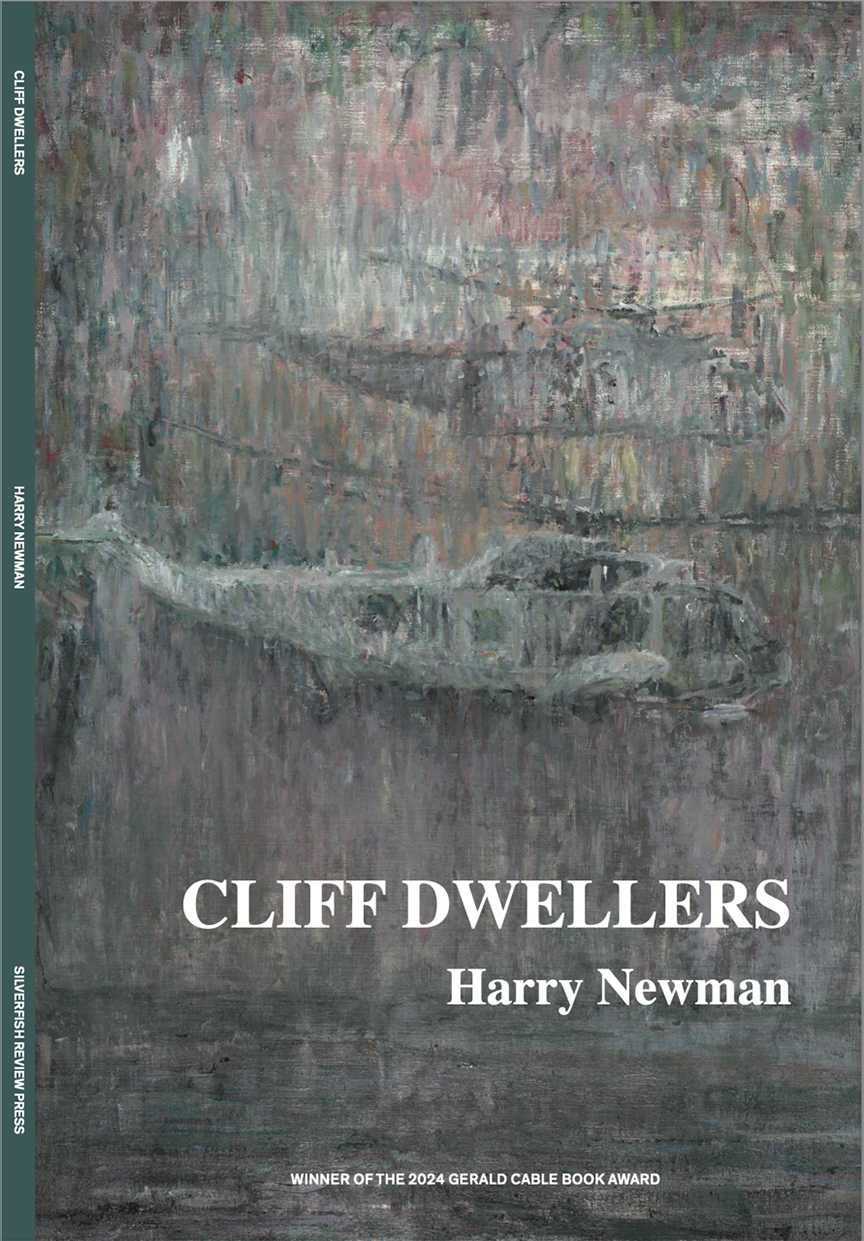
Congratulations to Harry Newman on the cover reveal for his upcoming collection, Cliff Dwellers, from Silverfish Review Press. The painting by Sabine Moritz is titled Abendphantasie. Beautiful work!
an award-winning anthology dedicated to publishing innovative literary experiences

Interviews, insights, and recorded readings with our poets and writers.
Congratulations to Harry Newman on the cover reveal for his upcoming collection, Cliff Dwellers, from Silverfish Review Press. The painting by Sabine Moritz is titled Abendphantasie. Beautiful work!
Congratulations to CLR contributor Matthew James Friday on the recent publication of two new poetry chap books by Bottlecap Press: Strange Beauty and The Be-All and the End-All!
Another wonderful poet, another wonderful chapbook—from Finishing Line Press! Congratulations to Benjamin Green, author of His Only Merit!!

Another bit of congratulations are in order: Scott Parker’s collection of essays, Teaching without Teaching, is just out from One Subject Press! We are so privileged to publish such wonderful writers.
Congratulations to CLR contributor Dallas Crow on the publication of his second poetry chap book, Troutwatching, by Finishing Line Press!

“Regarding the bathroom: The description is so vivid. What bathroom was this based on?”
The bathroom in the first section is from my childhood home. The turquoise bathroom in the other sections is in the house where I live now, so I use it every day. The previous owners were very fond of color, so I have a turquoise bathroom and a pink one. The living room was green, and the kitchen was purple when I moved in. I painted the kitchen white but kept the other colors.
“What inspired you to tell a life story through the aging and evolution of a bathroom?”
We had a prompt in a workshop to talk about a room and color. I had been thinking about having the bathroom repainted, so it was on my mind. Then I remembered the sky blue bathroom back home and lines started coming to me for this poem. We spend an awful lot of time in the bathroom but rarely talk about it and certainly don’t write poems about it. There are stories there if we look.
“In the third and fourth cantos, the woman seems quite lonely. How do you envision the woman spending her Christmas Eve?”
She is lonely without her husband. I envision her going to Mass on Christmas Eve, then spending the rest of the holiday alone by the little Christmas tree she put up herself. You’d be surprised at how many widows find themselves in this situation.
“What brought you to write about bears in enclosures specifically?”
On a visit to Sitka, Alaska, I went to the Fortress of the Bears. These were bears that would never be released back into the wild. As with any captive animals, there is a sadness. As a young child I certainly never saw it that way. But that visit triggered memories of going to the zoo and seeing that particular bear and it was striking how I felt about it so many years later.
“Seeing the first couple of stanzas, are you experienced with bears in any way? If so, how?”
When my husband was battling cancer, friends sent us tiny Zuni bears that became tokens for us – we would take them to hospital visits. We began to get more bear items so now I have many bears in the house and as my husband passed away, they are a sweet reminder of him. I’ve been lucky enough to see bears in the wild twice – never in a dangerous situation.
“Why did you choose to write “Bears” as a poem and not a short story?”
Although I do write short fiction, I am primarily a poet and it was a natural inclination to approach this topic through a poem, distilling the various influences of bears while exploring their emotional resonance.
“Could you tell us who inspired the character in this poem?”
My son was shooting wedding photos for a friend of his wife’s family in Cathedral Park under the St. John’s Bridge in Portland, and I had come along as an equipment carrier and back-up photographer. At least two other photographers were at the park shooting portraits (one of another wedding couple and one of a high school senior). Not a native Portlander, I had never been to Cathedral Park and was struck by the beauty of the scene and the brides. I began to imagine how the mother of a daughter or daughters might view the scene, so the “one woman” of the poem is mostly imaginary.
Being a poet of a certain age, I often think of my own receding and my own children having outgrown me and surpassed me in accomplishments. So I thought about how a woman might think of herself on that bridge suspended between (first) her life as young bride and new mother and (later but not that much later) the mother of brides.
“Why did you choose to keep your poem in one long stanza instead of breaking it up?”
I kept the poem as a single stanza because life–especially for this “one woman”–is a single short bridge from past to future. I think this might be a projection of my own experience of parenthood. It all went by so fast. Presto change-o from baby to toddler to teen to married and gone.
Though I am hesitant to use the word ‘writer’s block’ (especially in the world of creative nonfiction and poetry, where memory and experience are never-ending writing material; Example: any moment from your childhood) I truly believe that reading is the best cure for a creative stall. Read anything; read everything. And most importantly, read for enjoyment. You can’t read a book intending to find a cure for your block. It will ruin the book and you won’t find what you’re looking for. You’re writing will most likely be tainted. Instead, read and allow your mind to rest, to learn from and enjoy the way words dance on the page. In my experience, your next idea will just come to you, as long as you allow it.
-Darius Atefat-Peckham, 20th Anniversary Issue
How do I deal with writer’s block? Badly, of course. It’s terrible and the doubt and frustration from it only make it worse. But I don’t exactly have trouble writing, the times I’ve stopped. It’s more that I have trouble feeling. Feeling deeply enough to reach the level I need or want creatively. Either from being pulled in too many different directions and it’s hard to maintain focus or because I get overwhelmed by personal or professional circumstances. The kind of writing I do is very emotional and I need to have an open channel to those emotions and be able to sustain them to have a chance to do it well.
-Harry Newman, 20th Anniversary Issue
There are two things that thwart writer’s block. In my seminars at Lesley University, William Lychack was fond of reminding us that the only way to write is to keep your butt in the chair. If you don’t sit down to write, you’ll never write. That’s solution number one.
Solution number two is to figure out what motivates you. I’m a people-pleaser, so I love deadlines. They are one of the top ten things I miss about grad school. Knowing someone else is expecting my words is inherently incentivizing. Now, the only person expecting my words is myself—that requires an inordinate amount of self-discipline. When the writing isn’t going well, it’s easy to stumble into writer’s block. I combat this by keeping my butt in the chair and by finding someone else to expect my words. I employ my friends and family members to pester me about my work. Because I don’t want to disappoint them, I plow right on through writer’s block.
-Heather Charton, 20th Anniversary Issue
Writer’s block often hits me when I am least interested in a piece I’m working on. Usually, this happens at the mid-point in a story (after the initial excitement of an idea has worn off) or at the very end (when I need a viable and compelling conclusion to the story). When writer’s block hits I make a concerted effort just to get words on the page. There’s a moment when I stop caring about quality (and maybe even content) and I just try to write whatever I am thinking about for however long I need. I’ll often think about some of my favorite writers, and, in a moment of utter frustration, I’ll try to write something in their voice, to mimic it as perfectly as possible. Though it doesn’t always mean I add great content to whatever piece I’m working on, it’s often a decent exercise to get my brain going again. One of my very favorite professors encouraged taking walks to avoid the zombie-effect of sitting too long staring at words on a screen, and I find that very helpful as well.
-Tyler Wilborn, 20th Anniversary Issue
What was the inspiration for “What We Knew”?
My dad has an unusual hobby: fireworks. But he is not the only one. A few years ago, he became a card-carrying member of Pyrotechnics Guild International and then convinced my mom and me to attend a couple of their conventions with him. At these conventions, the fireworks were amazing, but the people were incredible, too. Their delightful passion for all things “pryo” were the beginnings of “What We Knew.”
The point of view came next. I’m a small-town Midwesterner, which makes it hard to get away from the effects—both good and bad—of community. I am fascinated by a town’s group mentality, the way it’s alliances shift and develop. In “What We Knew,” I used the focal point of fireworks to play with that social dynamic.
What made you decide to become an author?
When I started my undergraduate program at Kent State, I knew that I loved words and that I wanted to be a teacher. Then I took Joey Nicoletti’s Intro to Creative Writing course. He opened up to me the idea that I could not only teach others to love and use words but that I could also use them myself. He showed me that being a writer was a possibility. After his class, I still loved words and I still wanted to be a teacher, but I also wanted to be a writer. I took every writing class I could at Kent and then pursued my MFA at Lesley University.
Do you have any other pieces you’re intending to release soon or are working on?
I had another short story—“Grounded”—published in Bird’s Thumb this February. I currently have a few short stories in the submission process and am beginning to look for an agent for my first novel.
 CLACKAMAS LITERARY REVIEW